
Whether that audience pays for anything
What we are solving
Section titled “What we are solving”I picked the niche by intent in the first place: I took the keywords where the intent reads transactional or commercial, because on the rest people read and leave instead of buying.
And then the part the guides stay quiet about starts. You have to write content often, then check the new pages got into the index at all and that the keyword actually carries weight on them — otherwise there are no impressions even in theory.
Impressions are half of it. Turning one into a click means climbing the results, and hardly anyone scrolls as far as page four 😀
So volume answers one question, whether they search. Whether they pay is a different question — look at it before you have written anything, not after.
Who is already selling on your query
Section titled “Who is already selling on your query”Start here: the check costs nothing and takes a minute. Run your main query and read who is standing on the results page. A product with a pricing page in the top ten means somebody already tested this market with their own money.
site:example.com pricingRead their price the same way, writing down the shape rather than the number: per seat, per action, per month, a free tier with a wall in it. Your own figure goes there later; the shape tells you what people here pay for.
Ask yourself this before you have written anything, because afterwards you are no longer checking, you are looking for justifications.
Is anyone putting money on this query
Section titled “Is anyone putting money on this query”The ads above the results are people paying for a click and repeating the purchase, because nobody buys the same audience a second month running if that audience does not spend.
Count them by hand: run the query and look at how many ads sit above the organic results. A panel like Semrush shows an Ads field, but that is its own count of ad copies in its database, not what a person sees today.
Here are two live groups, read on the same day:
| Group | Volume (US) | CPC | Ads |
|---|---|---|---|
ai voice agent | 1,900 | $16.18 | 14 |
youtube transcript | 60,500 | $0.86 | none |
Demand for youtube transcript is thirty-two times bigger. And there is no money behind it at all: sixty thousand searches a month and not one advertiser is not a market, just people who need a free tool.
Here is what those fourteen look like on the live page:
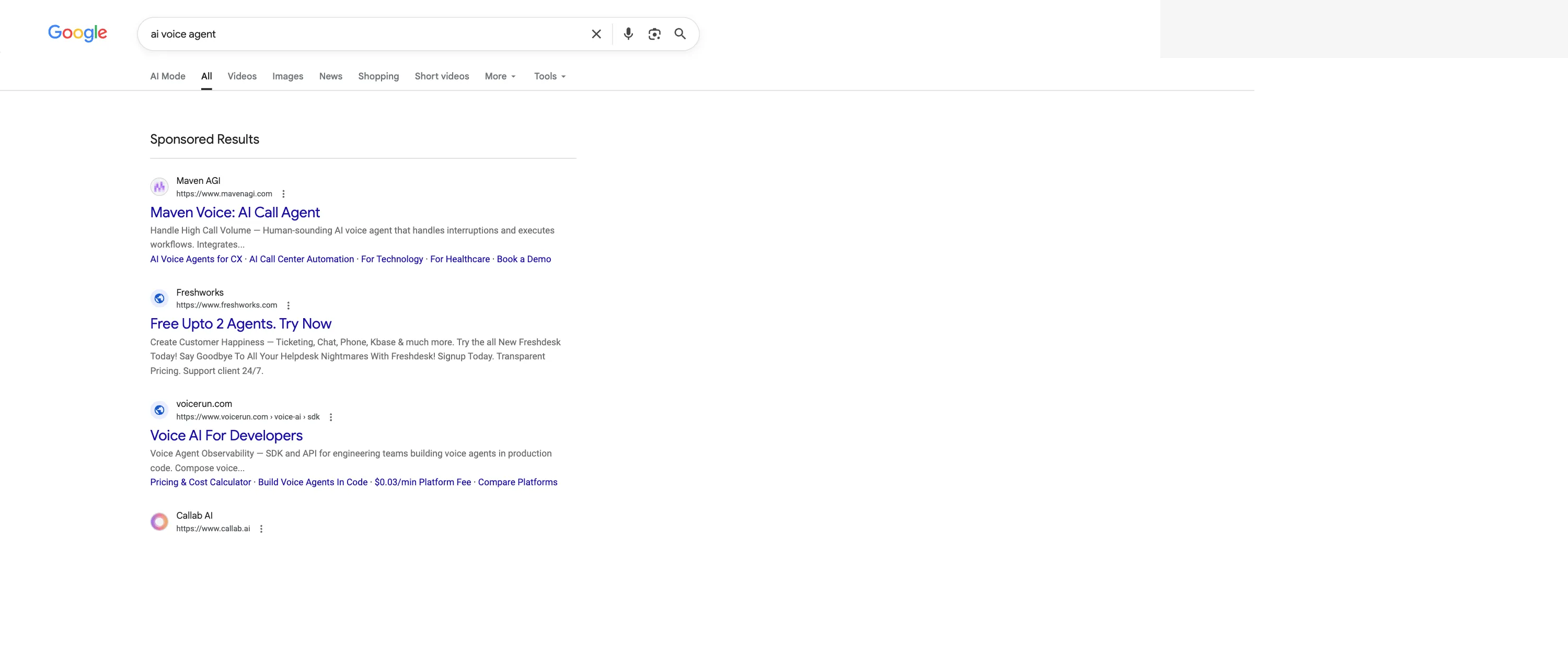
Four ads fit on the first screen, and every one of them cuts the niche by vertical: for healthcare, for developers, a per-minute platform fee. People buying ads that way know who they are selling to. Read 12 August 2026.
What free path does the person have right now
Section titled “What free path does the person have right now”Your price competes with the free way, not with the competitor’s price: usually that is a feature of the platform itself, an open-source script, or doing it by hand in ten minutes.
Check it on your own query, reading the suggest. If the word “free” crawls into it, you have your answer already, and in my Russian group голосовой бот the word for free stood in the top five twice.
Come back to this once a quarter. Platforms ship features, and the free path appears on its own.
Ask for money before the thing exists
Section titled “Ask for money before the thing exists”This is the most unpleasant and the most honest check: name a price, give a payment link, set a date. A pre-sale proves one thing — this person, at this price, today. Not a market, not a second person, and still more than most people have.
Record the refusals in the person’s own words, not as a paraphrase. “I would use the free one” and “my employer would never approve this” are two completely different products, and only one of them is worth building.
Say the break-even out loud before the price
Section titled “Say the break-even out loud before the price”Take the fixed costs, divide by the contribution from one payer, round up to whole people. You get a number like “twelve people a month”.
Compare it with the number of people you have actually spoken to. Break-even bigger than that is not pricing, it is hoping. The arithmetic is on what one user costs.
What did not work
Section titled “What did not work”- Treating volume as demand for a paid product. The phrases were real and so were the people typing them, only almost everyone who arrived wanted the free way: the pages ranking above me explained how to get the result without paying.
- Reading one impression as a statement about demand.
stt моделиsat at position 1.0 with 1 impression and 0 clicks in three months, and I read that as a phrase nobody types. Search Console counts how often my page was shown, which is a fact about me: what a paid rank tracker measures. - Reading signups as willingness to pay. Free signups arrived, used the product and came back, but not one converted. And the signup counter kept climbing the whole time.
- Missing the free alternative the platform itself shipped. The platform I build on gives the same function to its own paying subscribers, so for a large part of that audience my price competes with a feature they already have.
- Counting my own test purchase as revenue. The model showed break-even reached for a day. The payer was me, through a test account.
- Cutting a fixed cost of a couple of dollars while there were no payers. The denominator was fine as it was, and without a first payer there is no break-even. The work was here and not in the billing console.
- Building a scenario matrix instead of talking to one person. The optimistic and pessimistic columns are opinions about a margin nobody has earned. One person refusing a real price settles it faster.
Verify
Section titled “Verify”- Name the paid competitor on your main query and link to their pricing page. If there is none, do not treat the market as yours, and ask first why it is empty.
- Run the query and note whether ads appear. Repeat it a week later: one day of ads says nothing about a budget.
- Write down the free path to the same outcome in one sentence, including whatever the platform ships itself.
- Ask a real person for money at a real price and keep the answer verbatim, refusal included.
- State your break-even as a whole number of payers. If you cannot say it out loud, your price is a guess with a confident face on it.
Ads, CPC and intent read side by side across three niches: which market to build for.
If both questions came back yes, the next wall is technical rather than commercial: search has to be able to read the site at all. That is indexing.