
The words people actually type
What we are solving
Section titled “What we are solving”My bot transcribes voice messages, and I called it Voice AI. I wrote the pages around that name and waited a month. All that time people were typing «бот расшифровка голосовых» — in Cyrillic, in words my pages did not contain once.
The nastiest part is that nobody tells you. Nothing breaks: the pages are up, the crawler takes them, the logs are clean, and the queries simply land on somebody else. You will not find out until you go and look.
So do not start with how to rank. Start by checking whether anybody types this at all.
What the paid panels actually measure
Section titled “What the paid panels actually measure”Semrush, Ahrefs, Similarweb, Serpstat, Topvisor and Moz sell one shape of answer — a number next to a phrase — so work out what they measure with, and only then look at the number.
None of these services measures your site. They estimate it from outside: their own crawlers and purchased clickstream, and clickstream is a panel of anonymised sessions run through a model.
That is why their traffic figure never matches Search Console: Search Console counts events on your own property, and a panel extrapolates from other people’s browsers.
| Tool | What its instrument actually is |
|---|---|
| Semrush | Third-party SERP collection and a clickstream panel, modelled into volume and traffic |
| Ahrefs | Own link crawler, plus a keyword database with clickstream-corrected volumes |
| Similarweb | Panel and partner data extrapolated to whole-site traffic, plus a rank tracker for up to 200,000 keywords |
| Serpstat | Keyword and SERP databases: Google across 230 regions, plus one Bing database for the United States |
| Topvisor | Rank checks in the engines you pick, priced per check |
| Moz | Link index, plus a keyword explorer with modelled volume ranges |
Which of them reads Yandex at all
Section titled “Which of them reads Yandex at all”Then the main thing. If your audience speaks Russian, ask which of these tools reads Yandex.
Semrush documents position tracking for Google, Bing and Baidu. Yandex sits in its traffic block as a source label, and there is no Yandex rank database there.
Serpstat does not read Yandex either. Its own list of databases is Google across 230 regions plus one Bing database for the United States.
That leaves one of the six, Topvisor. It checks positions in Google, Yandex, Yandex.com, Bing and Seznam, and it takes volume from Wordstat as well as Keyword Planner.
Only it is a different instrument, not a cheaper Semrush: it checks the phrases you hand it and bills per check, and you cannot browse somebody else’s market through a ready database there.
Picking by database size makes no sense here. A panel that does not read Yandex shows you part of a Russian-language market. It will not tell you which part.
Eighteen times apart on one phrase
Section titled “Eighteen times apart on one phrase”I measured that gap on one phrase, in one day: голосовой бот, all regions, 10 July to 8 August 2026.
Wordstat returns 7,034 requests, and Semrush on db=ru, the same phrase read the same day, returns 390.
Eighteen times apart. Neither figure is a mistake: these are two different engines, and the smaller number belongs to the one serving the smaller share of the demand.
That is what skipping “name the engine” costs. On the strength of that 390 I described Russian-language demand in this atlas as a twelfth the size, though the panel made it a twelfth, not the market: which market to build for.
What a panel says about your own property I measured separately: what a paid rank tracker measures.
What the tail looks like from the inside
Section titled “What the tail looks like from the inside”One step down the demand is narrower, and people ask for the same thing six ways: бот расшифровка голосовых, all regions, 12 July to 10 August 2026 — 357 requests in the window.
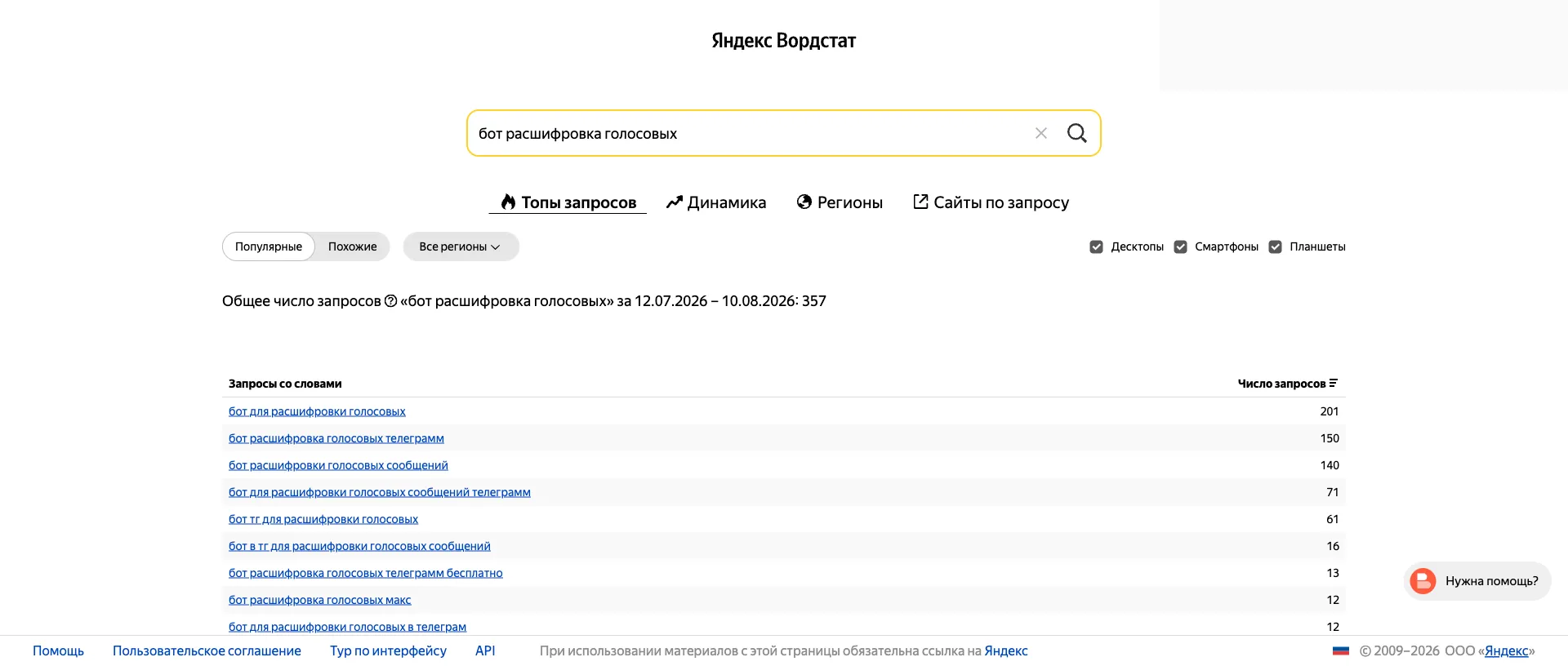
Yandex Wordstat for бот расшифровка голосовых, all regions, 12 July to 10 August 2026, read on 13 August 2026. The largest wording in the list is 201, and the ones after it are 150, 140, 71, 61 and 16.
That is what a tail looks like from the inside: six ways of asking for the same bot, none of them big. At my desk I would have guessed two, and бот тг для расшифровки голосовых I would never have written down.
The harvest no panel does for you
Section titled “The harvest no panel does for you”Now the harvest itself, which no panel does for you.
-
Harvest the phrasings, do not invent them — support messages, reviews, forum threads, the search box inside your own product. Write down exactly those words, the clumsy ones included. Your own vocabulary is the least reliable source in the room.
-
Open Yandex Wordstat for Russian demand — type the problem, not the product name. Wordstat is free and needs a Yandex account. No Russian-speaking audience? Skip steps 2 to 4 — nothing later depends on them.
Read the second column too: it holds what the same people searched next, and usually the vocabulary you lack.
-
Pin the phrase with operators before you believe the number — quotes narrow it to that phrase,
!fixes the word form. A bare phrase collects every query that contains it. That is a category total, not demand for your wording. -
Read Yandex suggest as a separate source — start typing and stop. The dropdown is what people actually picked, not a forecast. It disagrees with Wordstat often enough that I read both.
The two engines also disagree with each other, and one intent is enough to show it — Google and Yandex on the same job, read on 13 August 2026:
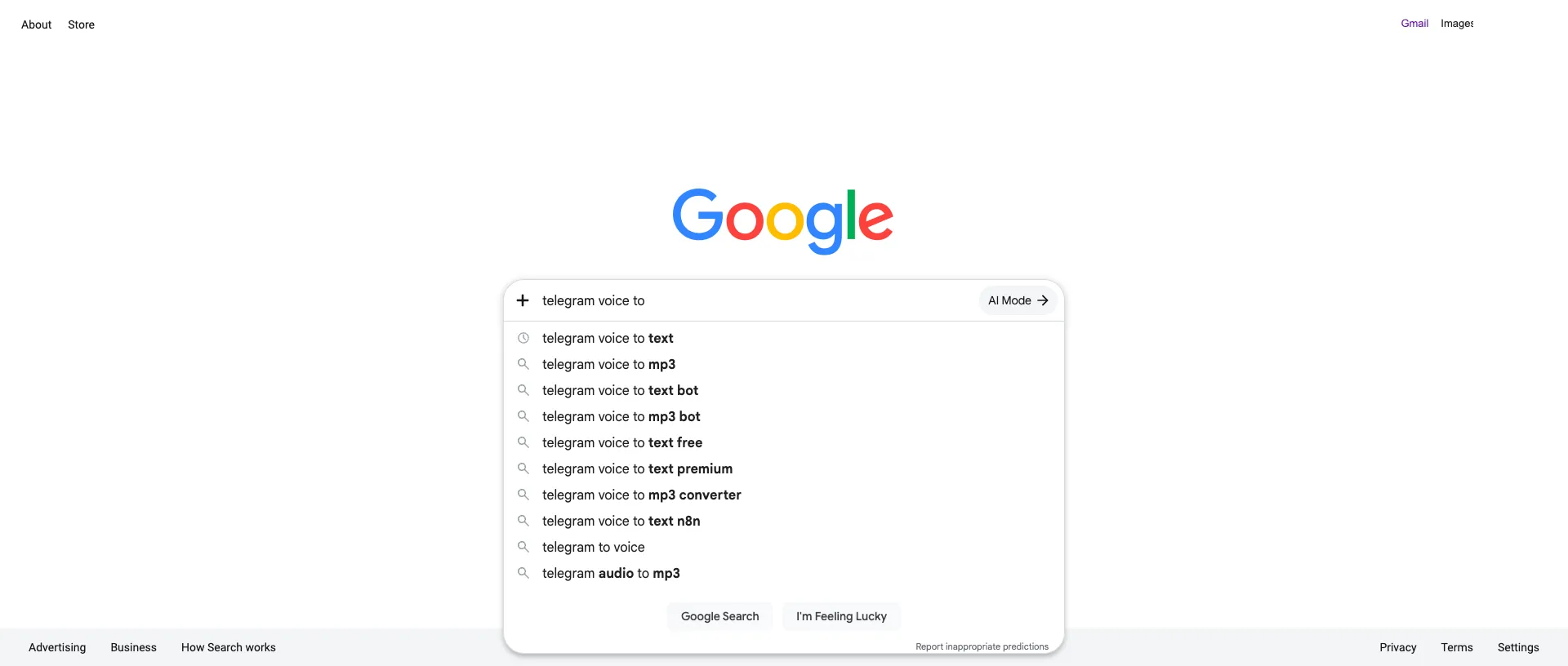
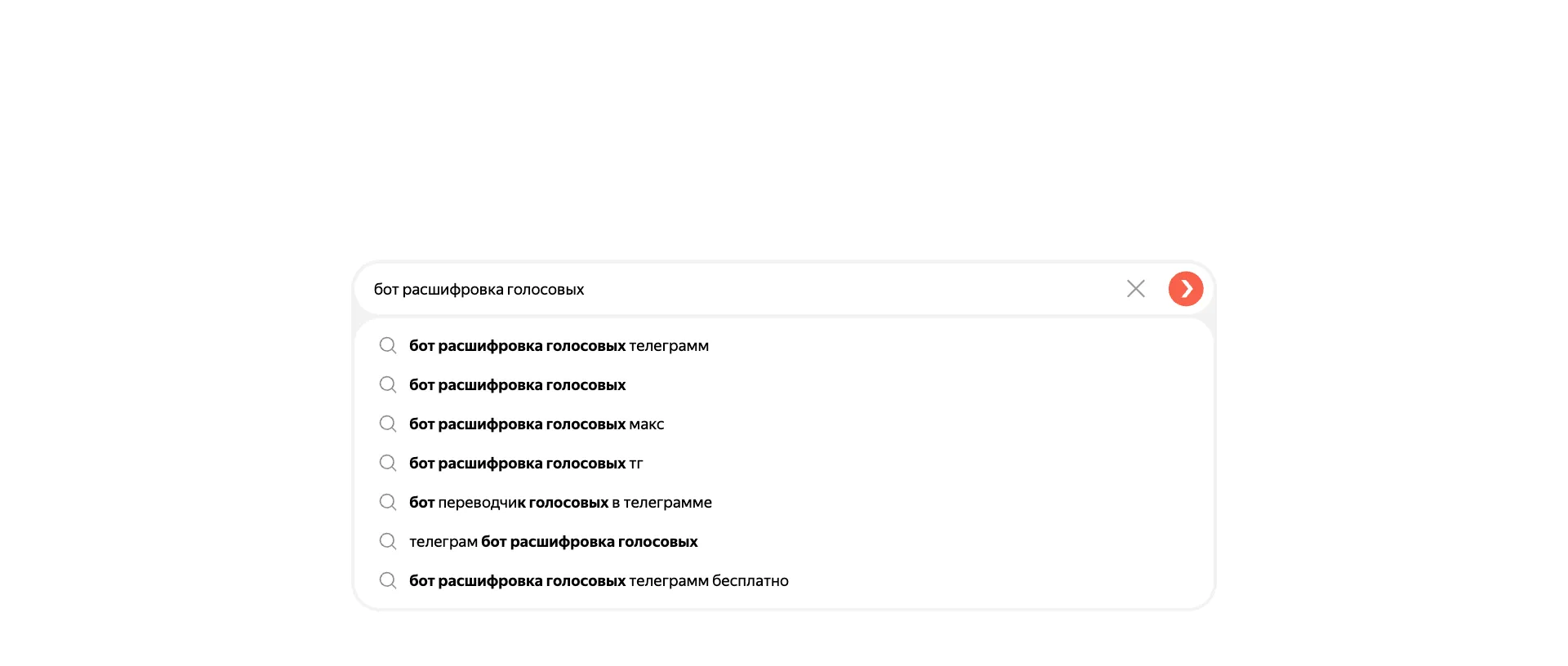
Google completes to
free,premiumandn8n— someone comparing plans and wiring up automation, and Yandex completes toтелеграмм,тг,бесплатноandмакс.That last one is worth a stop. MAX is a separate messenger, and part of the audience wants transcription inside it. Without support that is demand you cannot reach, and nothing but the dropdown would have said so.
-
Do the same in Google for English demand — Keyword Planner for the ranges, then the suggest. Planner lives inside Google Ads and needs an account with billing attached, about twenty minutes with a card; the suggest needs none.
Without Planner there are no counts, only the shapes of demand. Its ranges widen without an active campaign, so read them as an order of magnitude.
-
Search inside the platform where the product lives — the store, the marketplace, Telegram. Write down who came up on top. Competitor names from there are a free list of the exact words the demand speaks in.
-
Separate demand for a solution from demand for your product — problem queries against brand queries. Brand queries are demand you have already earned, and problem queries are the market: only they can grow while nobody knows your name.
-
Read a zero as a signal, not as noise — especially on the phrase that seems most obvious to you. It means one of two things: nobody has this problem in those words, or you invented the word. Both findings are cheaper now than after the texts.
What did not work
Section titled “What did not work”- Naming the product in Latin script while the demand was typed in Cyrillic. The words were right and the alphabet was wrong. Queries in the audience’s script could not reach the product at all, and nothing was logged, because nothing failed.
- Reading my user base as proof of the market. The geography of signups matched the Latin spelling of the name, not the market I was building for. I spent weeks on product theories about an audience one metadata field had created.
- Assuming my vocabulary was the market’s. My word for the core feature was not the word people typed: the pages existed, the demand existed, and they passed each other.
- Carrying a Google-only volume into a decision about Russian-language demand. I took 390 for
голосовой ботout of Semrush’sdb=ruand compared it with three English-speaking markets. Wordstat gives 7,034 for the same phrase and window. Both are real; one is about the engine that audience uses. - Believing a vendor’s overview over its own list of databases. Serpstat’s overview mentions Yandex; its database list is Google and Bing only. For Russian-language demand that was the whole answer.
- Reading one panel as “the search market”. The tool reported Google, while the phrases were Russian and Yandex serves that demand too. There was not one row about Yandex, and a panel never warns you about the engine it cannot see.
- Waiting for a tool to say what to write about. Its topics report answered that the domain was too small or too new, and a service that reads an existing footprint does not create the first one.
- Buying the subscription before doing this by hand. It returned a keyword list and a competitor’s name — I could have got both in an evening with a browser. The subscription changed nothing about my next step.
Verify
Section titled “Verify”- Check your obvious phrase and a competitor’s phrase in the same panel, on the same day, and if yours comes back empty and theirs does not, that word is the finding.
- Run the phrase by hand on the live results page, with country and language pinned. Compare it with what the panel said.
- Search the platform from an account that has never touched the product, in the audience’s language, and note whether you appear at all and who is above you.
- Name the engine next to every figure you write down. In a Russian-language market a number without an engine cannot be used.
- Run one phrase through both engines before you trust either of them. Mine came back eighteen times apart, and that gap is the whole reason for this rule.
- You should end up with a file: one row per phrasing. Next to it write where it came from and which engine you checked it in. A row with no origin is your own vocabulary in somebody else’s suit.
One panel read across three niches and four markets: which market to build for.
The phrasings are the way into the second question: whether that audience pays for anything. Turning the list into pages comes much later: what to write about when nobody searches your name.