
Which market to build for
What we are solving
Section titled “What we are solving”Three niches looked plausible at the same time. I had nothing to order them by: each carried its own phrase, its own market and no reason at all to prefer it to the one beside it.
So I ran all three through one instrument on one day — Semrush Keyword Overview, read on 2026-08-12, one database per market.
The rest of this page is that single pull. It is an estimate made from outside by somebody else’s panel on somebody else’s data, so what it does not cover I wrote down right before the procedure rather than in small print at the end.
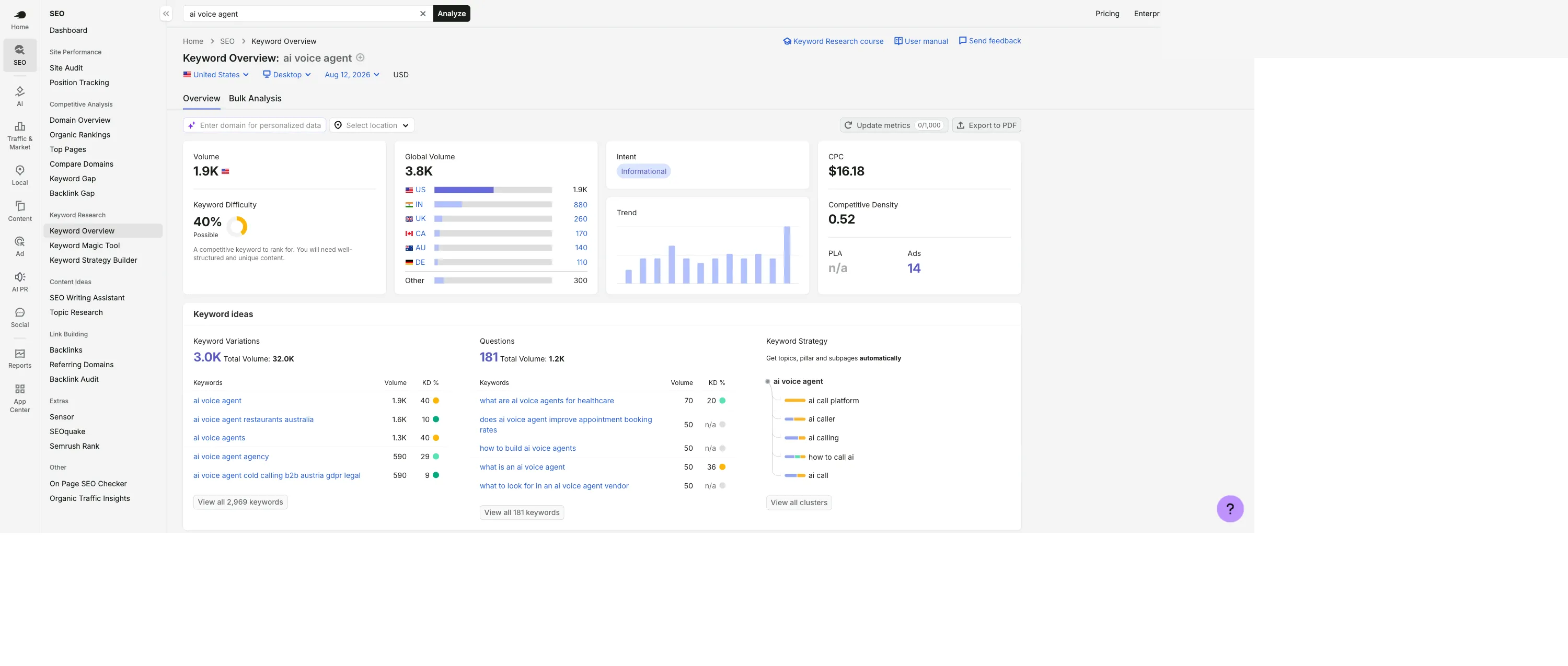
Keyword Overview for ai voice agent, United States database, read on 2026-08-12. Small volume, an expensive click, fourteen advertisers, and a long tail at difficulty 9 and 10.
What this instrument is, and how to get at it
Section titled “What this instrument is, and how to get at it”Semrush is a paid panel that estimates search demand: how often a phrase is typed in a month, what a click on it costs, and how hard the top of the results would be.
The load-bearing word is estimates. By its own documentation Semrush gets nothing from Google: it buys results pages from third-party providers, reads the top hundred positions and models the rest. Volumes refresh daily to monthly, depending on the phrase.
Two things follow. A number in the panel is a model, not a counter, so write the database and the engine beside it. And the databases are built on Google, which is why the panel sees Russian demand poorly: on my phrase it disagreed with Wordstat eighteenfold.
So why I use it anyway. It puts volume, click price and advertiser count on one screen in one set of units. Assembling the same thing free from three separate places does not work.
A free account takes an email and no card, and gives 10 queries a day against the domain, keyword, competitor and backlink reports — enough to check three or four phrases once.
The full panel opens with a seven-day trial, and that one wants a card. Cancel any time; forget to and it rolls into a paid subscription.
Set a reminder for day six. Doing all the counting in one sitting is better anyway: read every phrase on the same day, or your numbers come from different measurements.
Do not buy access through a reseller. The account is shared and the limits are shared, and you are paying somebody who has no relationship with the vendor at all.
Three niches, one market
Section titled “Three niches, one market”All three phrases read in the United States database, on the same day. This is how you open it — substitute your phrase and your database:
https://www.semrush.com/analytics/keywordoverview/?q=ai+voice+agent&db=us| Phrase | Volume | CPC | Keyword Difficulty | Intent |
|---|---|---|---|---|
youtube transcript | 60,500 | $0.86 | 70% | Navigational |
pdf to text | 9,900 | $0.79 | 43% | Informational |
ai voice agent | 1,900 | $16.18 | 40% | Informational |
Volume and money went in opposite directions here: youtube transcript has 32 times the searches of ai voice agent, and a click there is worth 19 times less.
The variation cluster does not rescue youtube transcript either. It carries 4,900 keywords on 382,600 volume, while pdf to text carries 15,900 on 247,600.
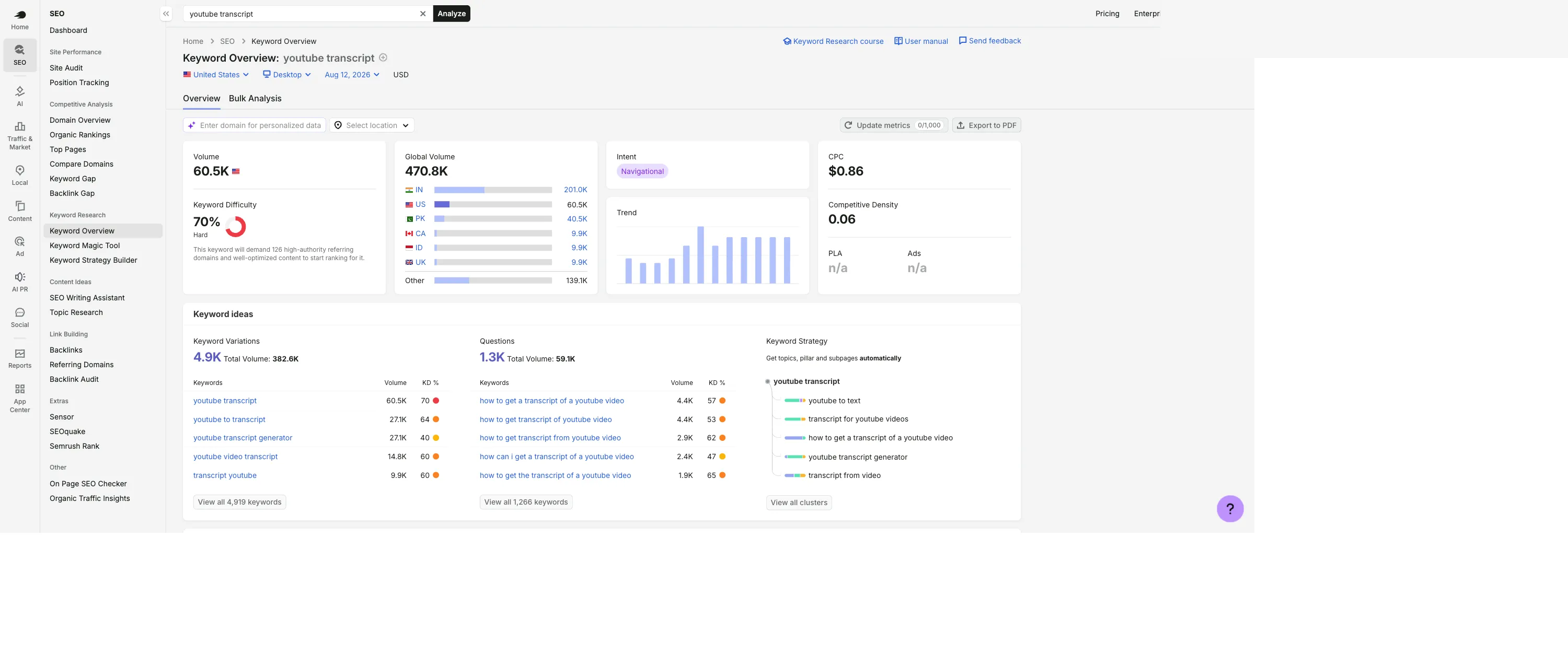
Keyword Overview for youtube transcript, United States database, read on 2026-08-12. The headline number of the three, at the cheapest click and the hardest entry.
Intent decides what you can charge for. Navigational means the person wants one specific free tool; Informational means they want to work out how it is done. Neither of them buys a subscription.
The panel puts the commercial reading somewhere else entirely, and you will see it in the next table but one.
Difficulty runs the same way: 70% on youtube transcript against 40% on ai voice agent. Semrush’s note under that 70% asks for 126 high-authority referring domains, which means the biggest niche of the three also turned out to be the slowest to enter.
The same phrase, four markets
Section titled “The same phrase, four markets”ai voice agent in three English-speaking databases, and the Russian-language equivalent голосовой бот in the db=ru one.
| Market | Phrase | Volume | CPC | Keyword Difficulty |
|---|---|---|---|---|
| United States | ai voice agent | 1,900 | $16.18 | 40% |
| United Kingdom | ai voice agent | 260 | $9.75 | 48% |
| Germany | ai voice agent | 110 | $9.91 | 40% |
ru database | голосовой бот | 390 | $2.65, no live auction | 64% |
The same idea pays $16.18 a click in the United States, $9.75 in the United Kingdom and $9.91 in Germany. So markets differ by a good deal more than the language on the page.
Three databases, one engine, one day. That part of the comparison held, and it is the part that picked the market.
The fourth row lives by different rules: it is not a market, it is a language. Russian speakers are spread across the CIS, and the panel hands you one country while passing it off as the whole demand.
Then the money in that row. Google stopped serving ads to users in Russia on 3 March 2022 and deactivated Russia-based publisher accounts in August 2024, so $2.65 prices an auction that does not run there. Ads do serve in Kazakhstan, Armenia and Uzbekistan, and those click prices have to be read separately.
The panel says none of that. It hands you a filled-in field, in dollars, and beside it sit three markets where that very same field means a live bid.
The rest of that row survives, with a label on it: volume, difficulty and the variation counts were read in Google only, and Yandex serves a large share of Russian-language demand.
The difficulty there is higher too, 64% against 40%. Only the panel scores it against its own database, so numbers like those cannot sit side by side.
Inside the panel the Russian-language branch looks thinner. 376 variations on 2,700 total volume against 2,969 on 32,000 in English. The question block says the same: 51 questions on 110 volume in Russian, 181 on 1,200 in English.
This page used to read that as a market about a twelfth the size. Then I typed the same phrase into the other engine.
The same phrase, the other engine
Section titled “The same phrase, the other engine”голосовой бот in Yandex Wordstat, all regions, 10 July to 8 August 2026: 7,034 requests. Semrush’s db=ru reported 390 for the same phrase. The two instruments are eighteen times apart.
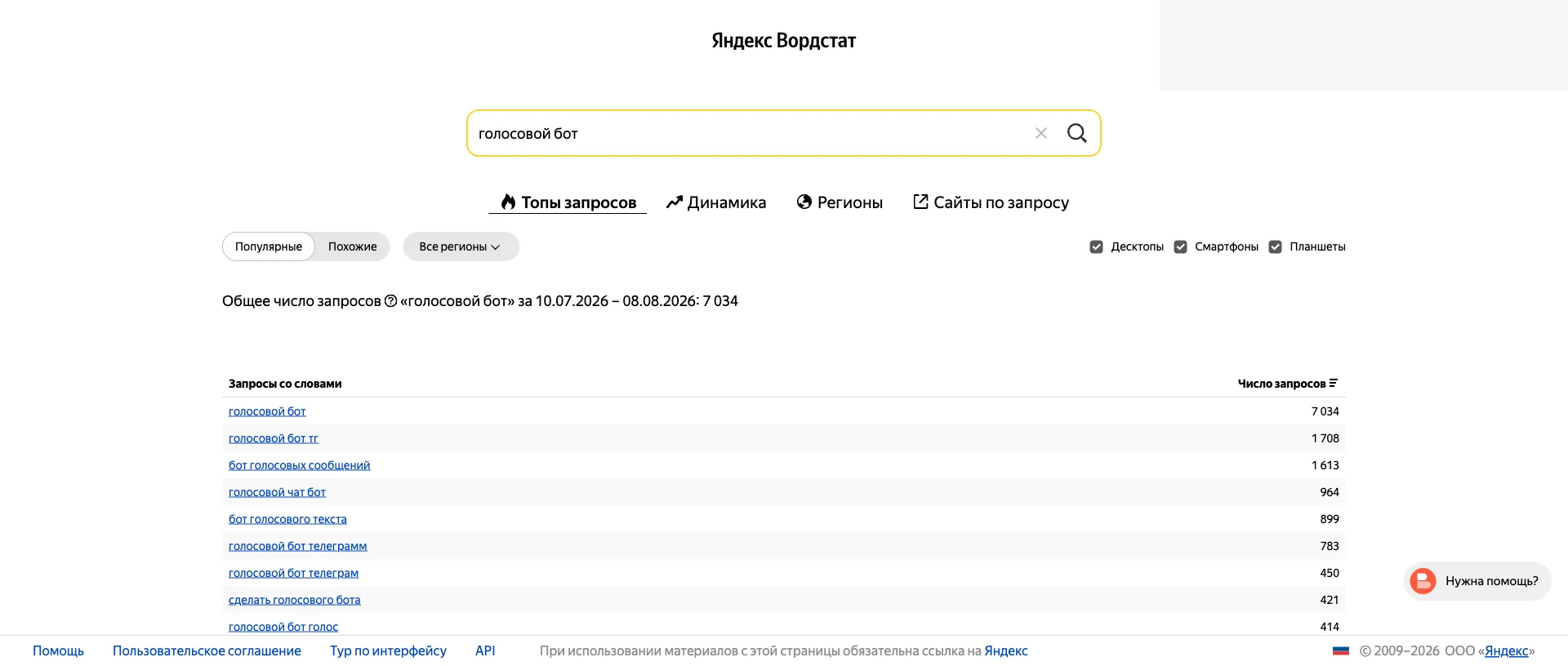
Yandex Wordstat for голосовой бот, all regions, 10 July to 8 August 2026, read on 2026-08-12. Semrush reported 390 for the same phrase.
The tail from the same window says it again.
| Phrase | Wordstat, one month |
|---|---|
голосовой бот тг | 1,708 |
бот голосовых сообщений | 1,613 |
голосовой чат бот | 964 |
бот голосового текста | 899 |
голосовой бот телеграмм | 783 |
голосовой бот телеграм | 450 |
сделать голосового бота | 421 |
голосовой бот бесплатно | 357 |
бот для расшифровки голосовых | 197 |
бот перевести голосовое в текст | 146 |
бот расшифровка голосовых телеграмм | 146 |
Seven of those rows carry more volume on their own than Semrush reported for the head phrase. The twelfth was never a fact about the market — it is the distance between two instruments, one of which cannot read that engine.
That leaves no four-market comparison: three rows come from Google, the fourth from Yandex, and numbers from different engines do not belong in one table. So the table above compares three markets, and the fourth row stands apart.
The rule that would have caught it was already on the page. Name the engine next to the number.
Two phrasings of one idea
Section titled “Two phrasings of one idea”Word order changes the reading. I read the rows below in the United States database, on the same day.
| Phrase | Volume | CPC | Keyword Difficulty | Competitive density | Intent |
|---|---|---|---|---|---|
ai voice agent | 1,900 | $16.18 | 40% | 0.52 | Informational |
voice ai agents | 590 | $16.94 | 39% | 0.41 | Commercial |
The commercial reading sits on the smaller phrase, and the click there is dearer. The phrase I build the page around decides who turns up on it.
More reliable than any price here is the advertising. Fourteen advertisers are bidding on ai voice agent at once — fourteen people paying for the click with their own money, and not for the first month either. The CPC beside them is a model’s estimate.
The long specific phrases
Section titled “The long specific phrases”Inside the English branch sit phrases with real volume and almost no difficulty.
| Phrase | Volume | Keyword Difficulty |
|---|---|---|
ai voice agent restaurants australia | 1,600 | 10 |
ai voice agent cold calling b2b austria gdpr legal | 590 | 9 |
ai voice agent restaurants australia carries more volume than the head phrase in the United Kingdom. I would never have invented it at my desk — it turned up in the variations list sorted by difficulty, which is where to go looking.
What these figures do not cover
Section titled “What these figures do not cover”- Every number here is Semrush’s estimate from outside. It is not a measurement of anyone’s property. Its one-day estimate and a ninety-day average from my property are different quantities: what a paid rank tracker measures.
- Keyword Difficulty is scored against its own database. So 40% and 64% are not strictly comparable across markets. Comparable within a market only.
- Semrush does not cover Yandex. For Russian-language demand that is a large hole, and this table is Google-only. On the one phrase I measured, the hole was a factor of eighteen.
- The CPC in the
rudatabase has no auction behind it. Google has not served ads to users in Russia since March 2022, and the field is filled in all the same. Other CIS countries have to be priced separately. - The English rows come from the United States database. The country split next to the global volume is volume only, not CPC.
Which phrasings to take before the tool is open
Section titled “Which phrasings to take before the tool is open”Take your own word, a near-synonym, and the word a competitor uses. One phrasing is a sample of one: ai voice agent and voice ai agents came back with different intent, and they were on the same screen, one row under the other.
What to read in the row besides volume
Section titled “What to read in the row besides volume”Volume on its own is not worth reading. Read it next to intent and CPC: a headline of 60,500 at $0.86 and Navigational is a crowd looking for a free tool.
Then the Ads field and the live results page: ai voice agent shows Ads 14, youtube transcript shows n/a on 60,500 searches a month.
And ask separately whether the auction behind that price runs at all. A price needs bids and bids need a country: Google has not served ads to users in Russia since March 2022, and db=ru returns a CPC in dollars anyway, unmarked.
How not to put two instruments in one table
Section titled “How not to put two instruments in one table”Re-read every phrase in its own market database. Switch the country by hand rather than translating in your head, and write the database name next to every figure, because a number without its database compares to nothing. That is where it burned me.
How the choice ends
Section titled “How the choice ends”Name the market out loud, in one sentence, with a figure inside it. Mine came out as this: build for the United States, because the click there is worth $16.18 and fourteen advertisers agree.
What did not work
Section titled “What did not work”- Picking the niche by search volume. 60,500 looked like the goldmine of the three, at $0.86 a click, 70% difficulty and Navigational intent. I would have entered the slowest niche for the cheapest traffic.
- Assuming the domestic-language market is the easier one. The one panel I had cannot see Yandex, and the CPC it printed has no auction behind it. I had no instrument to answer the question.
- Sizing a market with the one panel that cannot see it. This page said the Russian branch was a twelfth of the English one, on Semrush’s 390. Wordstat gives 7,034 for the same phrase in the same month. The figure described my instrument, and I put a caveat above it instead of deleting it.
- Reading a CPC without asking whether the auction exists. I put $2.65 next to $16.18 and called it a comparison of markets. Google has not served ads in Russia since March 2022. Nobody pays one of those two prices.
- Letting a filled-in field stand for a fact. The panel had no empty cell to warn me, so I read a populated column as a measured one. A field is filled because the model can produce a number.
- Treating one phrasing as the whole niche. I read
ai voice agent, saw Informational, and nearly wrote the niche off.voice ai agentsreads Commercial at $16.94. It was one line further down the same screen. - Reading CPC without the ad count. A price with nobody paying it is a forecast. Ads 14 is fourteen live bidders, and it is the field I checked last.
- Comparing difficulty across databases as one scale. I put 40% and 64% in one row and drew a conclusion for a day. The panel scores difficulty against its own database, so that row compares nothing.
- Reading the country split as a market list. US 1,900, IN 880, UK 260, CA 170, AU 140, DE 110. The split is volume only. India at 880 says nothing about what a click there costs.
- Taking the panel for a measurement. These are modelled figures about markets I have not entered. I once set its estimate beside a ninety-day Search Console average — two different quantities, not a verdict on either: what a paid rank tracker measures.
Verify
Section titled “Verify”- Write one row per phrase with all four fields in it: volume, intent, CPC, ads. A row missing a field is not a decision yet.
- Re-run each phrase in its own market database and put the database name next to the number. Two numbers without databases are not a comparison.
- Count the ads by hand on the live results page, on two separate days. One day of ads proves nothing about a budget.
- Name the engine behind every row, and for Russian-language demand check Wordstat as well. On my one phrase the two engines were eighteen times apart — the words people actually type.
- State the market you picked in one sentence, with the figure that decided it. If the sentence works without the figure, you picked by taste.
In sum, the biggest number of the three was the worst niche of the three. The next question is whether the audience behind the expensive click pays anything: whether that audience pays for anything.